Improvement Kata in Action | Real Scrum Board Example | EBFC Scrum Community
The Chiles Method: How to Build a 5S Improvement Kata Scrum Board
By Mike Chiles | EBFC Scrum Community of Practice | February 19, 2026
I've been using Scrum for a while now, and one thing that kept hitting me was how much it overlaps with lean practices I already knew. The improvement kata, 5S, the Eisenhower matrix — they're all in there. You just have to connect the dots. So I did, and I want to walk you through how to build what I call the Chiles Method scrum board — a system that combines all three into one visual workflow you can use at work or at home.
This isn't complicated. You can do this with blue painter's tape on a wall. Don't let the full picture intimidate you. Let me break it down piece by piece.
The Building Blocks
Before we get to the board, you need to understand three lean concepts that make this work.
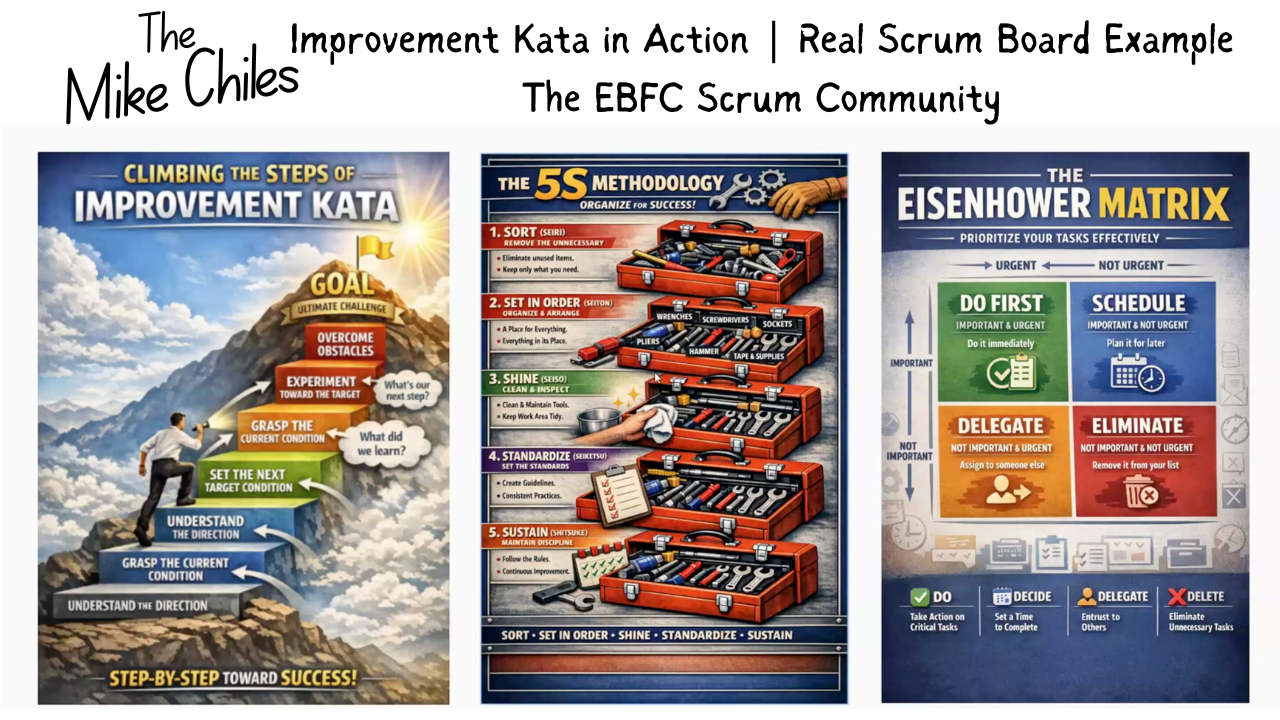
1. The Improvement Kata (a.k.a. GROW)
The improvement kata is a growth tool. You're at Point A, you want to be at Point B, and you need a structured way to get there. I rebranded it with an acronym that's easy to remember: GROW.
- G — Goal: Where do you want to be?
- R — Reflect: Where are you right now? What's working? What's not?
- O — One Smart Goal: What's one specific thing you can do to get one step closer?
- W — When: When are you starting? When are you checking back in?
That's the improvement kata in a nutshell. If you want to go deeper, look up Mike Rother on YouTube — he has some excellent keynote speeches on this.
2. 5S
You hear about 5S on job sites all the time — messy toolboxes, organized toolboxes. But it works for organizing your thoughts too. The five steps:
- Sort: What do you actually need? Get rid of what you don't.
- Set in Order: Give everything a home. Label it. Put it where it goes.
- Shine: Keep it clean. Keep it organized. One thing at a time.
- Standardize: Same process every time. Same agenda. Same review.
- Sustain: Keep doing it. Don't let it slide back into chaos.
When you make your to-dos visual — on a wall, on sticky notes, on a Mural board — it starts looking like that messy toolbox. 5S gives you the discipline to sort through it.
3. The Eisenhower Matrix
The Eisenhower Matrix gives you four quadrants to filter your tasks before they ever hit your sprint board.
| Urgent | Not Urgent | |
|---|---|---|
| Important | Big Rocks Do it now | Pebbles Schedule it |
| Not Important | Sand Delegate it | Time Wasters Eliminate it |
This is your filter. Everything in your brain dump runs through this before it hits your sprint board.
How to Build the Board
Here's the step-by-step. Grab some blue painter's tape, sticky notes, and a wall. Or open up Mural, Miro, or whatever digital tool you like.
Step 1: Set Your Goal
Write it down at the top of your board. Where do you want to be? This anchors everything. Every decision about what goes on your sprint board comes back to this goal.
If your goal is "get all my chores done this weekend," you'll prioritize differently than if your goal is "maximize time with my family." The goal changes how you filter.
Step 2: Brain Dump
Get everything out of your head. Don't think about order. Don't think about priority. Just dump it all onto sticky notes or a list. Every single thing on your mind.
This is where the stress relief happens. Once it's out of your head and visible, you can breathe. You know it's captured.
Pro tip: If you struggle with brain dumps, open your phone's voice memo app, hit record, and just talk. Say everything. Then take that transcript, paste it into your AI tool of choice, and ask it to organize it into a list. Copy that list into Mural — it'll automatically create separate cards for each item. You can also paste from Excel the same way. The goal is speed: get from thoughts to visual as fast as possible.
Step 3: Filter Through the Eisenhower Matrix
Now take your brain dump and sort every item into the four quadrants above:
- Important + Urgent → Big Rocks. These go on your sprint board first. If you don't do these, you're in trouble. They're getting you closest to your goal and they can't wait.
- Important + Not Urgent → Pebbles. These still matter. Schedule them after your big rocks have their spot.
- Not Important + Urgent → Sand. These need to happen, but can someone else do them? Delegate if possible. If not, they go last on your sprint.
- Not Important + Not Urgent → Eliminate. These are time thieves. Kill them.
Think about it like filling a jar. You put the big rocks in first, then the pebbles fill the gaps, then the sand flows around everything. If you start with sand, the rocks will never fit.
Step 4: Load Your Sprint
Set up your sprint board with columns. You can do it as days of the week (Sunday through Saturday) or as a standard flow (Backlog → Next Up → Doing → Done).
I prefer the flow layout. Think of it as a production line — work enters from the left, moves through "Doing," and exits to "Done." One-piece flow. The smallest movement possible.
Loading order:
- Big rocks get placed first
- Pebbles fill in around them
- Sand goes in if there's room
- Time wasters never make it onto the board
Step 5: Work the Board (Shine)
During your sprint, focus on one thing at a time. Move one item into "Doing" and finish it before pulling the next one.
Step 6: Review and Standardize (RAIN)
At the end of your sprint, run your review using RAIN:
- R — Recap: Did we do what we said we would?
- A — Align: Where are we going next?
- I — Identify: What constraints are in the way?
- N — Next Steps: Who owns them and by when?
Then run a quick Keep / Stop / Start and reload your next sprint.
Step 7: Sustain
The system only works if you keep running it. Same board. Same cadence. Every week.
Just Start Something
The hard part isn't the system. The hard part is starting. Do your brain dump. Sort your rocks. Load your sprint. And go.
Life's about relationships, and time is precious. The faster we get things done, the more time we have for what matters most.
So go get after it.
Mike Chiles is a member of the EBFC Scrum Community of Practice. This post is based on his February 2026 presentation combining Improvement Kata, 5S, and the Eisenhower Matrix into a unified Scrum board workflow.
Learn more at https://store.theebfcshow.com/the-ebfc-show-community

PPC - The Number on the Whiteboard




